Sunday, November 20, 2011

College Park Blues


The man facing the audience in cowboy hat and sunglasses sang and played with all of the experience one would expect from an 81-year-old man who had been performing in front of an audience since childhood. But the guitar licks and singing that cut the air that night had the energy and drive expected from a much younger man.
Warner Williams was playing the Fourth Annual College Park Blues Festival, held November 12 at the University of Maryland’s Ritchie Coliseum.
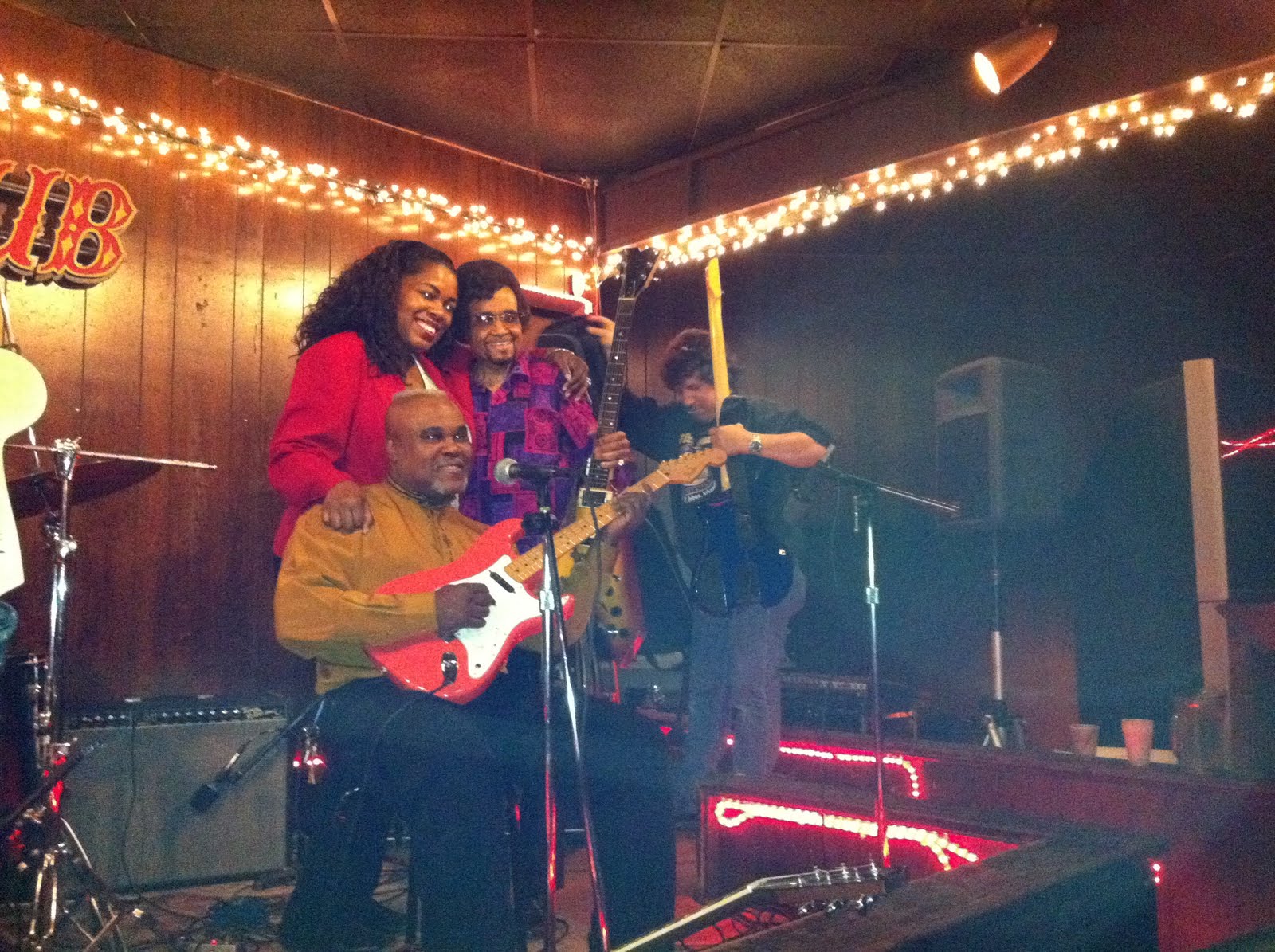
As the opening act, he was the perfect performer to set the bar for an evening of blues that would later feature Clarence “The Bluesman” Turner, the D.C. Blues Society Band with singer Ayaba Bey and guitarist Tom Newman and his band.
One of only nine people this year to win the National Endowment of the Arts’ National Heritage Award, Williams can arguably be seen not only as an American musical icon, but a piece of musical history. The National Endowment of the Arts describes him as a performer of “Piedmont Blues,” a storytelling style of music found in the region between Maryland to Georgia and west to the Blue Ridge Mountains. Williams, who said he likes to play blues and spirituals, playfully calls it “front porch music.”
That evening, the rapt, almost reverential attention he received from the audience seemed to recognize his status. Hardly anyone was talking, and few were looking at anything else in the room other than Williams as he played a set that acknowledged the Veteran’s Day weekend with an instrumental of “God Bless America” and also included his version of “Blueberry Hill,” the classic made famous by Fats Domino.
You can almost feel what I’m talking about in these videos of his performance. Here’s “Blueberry Hill:”
And this segment includes the instrumental I mentioned, plus other gems:

Up next was Clarence “The Bluesman” Turner, who will represent the D.C. area in January-February 2012 at the International Blues Challenge in Memphis. Turner, who plays bass in addition to guitar, first learned to appreciate the blues from his father’s collection of Howlin’ Wolf and Muddy Waters records. He started playing guitar at the age of eight and was playing clubs in the D.C. area by his early teens. Starting in his early 20’s, he dropped out of music for more than ten years, but eventually returned to the blues—and performing.
His band at the festival included Sean Graves on drums, Dave Satterwhite on bass, Avon Dews on harmonica and Chuck Pearson on keyboards/organ. Here they are with “She’s 19 Years Old:”

Then came the D.C. Blues Society Band with Ayaba Bey, who had previously performed at the 2011 D.C. Blues Festival. The band includes Sam’I Nuriddin on guitar, David Harris on harmonica, David Jackson on bass and Joseph Thomas on saxophone. Catch the solos by Harris and Thomas as the band plays “I Want to Make Love to You:”

Here they come back with “C.C. Ryder:”

The show ended with guitarist Tom Newman, who started performing professionally at age 16 and began teaching at age 18 while a student at Howard University. At Howard, he recorded the hit record “Let’s Do the Latin Hustle” with Eddie Drennon and the BSS Unlimited Band. Over the years, he has played with Stanley Turrentine, Roy Ayers, Lloyd Price, Wilson Pickett and others.
As you can hear in the following video, in which he plays “Hideaway,” there is a jazz flavor to what Newman does:

As we said before, Newman played with Wilson Pickett. Here he is with his version of “Funky Broadway:”

SHOUT OUT: By the way, the gentleman with the fancy dance steps shouting “Go ‘head” to the bands is Jeremiah. He is a big fan of the blues here in D.C. and the concerts would not be the same without him.

Tuesday, November 15, 2011

Rodeo Kings and Queens


When they formed Blackie and the Rodeo Kings in 1996, principals Colin Linden, Tom Wilson and Stephen Fearing were basically only thinking about making a one-shot tribute album to Canadian Folk Music Legend Willie P. Bennett, a musician they all viewed with reverence. But their effort soon took on a life of its own.
After a while the group—which takes its name from Bennett’s 1978 album Blackie and the Rodeo King—were playing live dates.
Eventually there was a second album, a double. Then a third album. Then a fourth. Along with them came awards and nominations for awards, including the Juno they received for their 1999 effort, Kings of Love. Blackie and the Rodeo Kings’ music even found its way to the IPod of U.S. President George W. Bush.

Fast-forward to the present, when the critically-acclaimed Canadian folk/rock/blues/country group has released Kings and Queens, its seventh album. Three years in the making, Kings and Queens features 14 songs that Linden, a guitarist known for his work with the Band; Wilson, former lead singer of the 1990’s rock group Junkhouse and Fearing, who has collaborated with high profile producers such as Steve Berlin of Los Lobos; recorded with several iconic “queens” of music, all but three American.
The high profile list includes Rosanne Cash, Exene Cervenka, Holly Cole, Emmylou Harris, Amy Helm, Janiva Magness, Mary Margaret O’Hara, Sam Phillips, Serena Ryder, Pam Tillis, Sara Watkins, Lucinda Williams, Cassandra Wilson and Patti Scialfa. The songs run the gamut from pop-chart contenders (“I’m Still Loving You” with Helm) to bluesy slow burners (“Shelter Me” with Scialfa) to country ballads (“My Town Has Moved Away” withTillis) to driving Tom Petty-style rockers (“How Come You Treat Me So Bad” with Magness) to lazy country wind-twisters (“Step Away” with Harris). There are songs where band members and guests individually duet up and others where everyone sings together in what Linden calls a “wild roving gang sound.”

Maybe because of its high infusion of American starpower, the album is gaining more of a foothold in the United States than previous Blackie efforts, says Linden, a Toronto native who now lives in Nashville. The band currently has dates in several U.S. cities, including here in the D.C. area where it will play Jammin Java in Vienna, Virginia on Friday, November 18. For those of you who will be in the D.C. area then, Jammin Java is located at 227 Maple Avenue East, Vienna, Virginia. The phone number is 703-255-1566 and Jammin Java’s website can be reached at
http://jamminjava.com/
Beldon’s Blues Point had a chance to talk to Linden about the group, the new album, and many topics in-between, including his friendship with the late keyboardist Richard Bell, who was known for his work with Janis Joplin. Linden started by talking about the group’s origins, which evolved from a night in which two of its founders co-incidentally came upon the same idea:
Linden: It was a wild bit of synchronicity. It was 15 years ago and I had been producing records for a number of years. I was an artist on Sony at the time. And my wife and I were sitting around our table and one of the things that was sort of the rage at the time was tribute albums and I was looking for a project to do for our company which we had just started. And I was thinking wouldn’t it be great to do a tribute album to our dear friend Willie P. Bennett, who’s such a great songwriter? Nobody knows, people don’t know how great he is. And his songs are fantastic. Wouldn’t it be great to do a tribute album to Willie? But maybe make it like it was a tribute band with just other singers and me. So instead of having 12 different artists do it, it’d just be like a common production and two or three different singers and it could be a really stylized great project. Okay. We’re talking about this. I take a break and walk over to my computer—this is in the early days of the Internet—and I get an e-mail from Stephen Fearing, who is a friend of mine, but I don’t really know him very well. Stephen says in his email “Wouldn’t it be great to get together and do a project of Willie P. Bennett songs sometime?” Very same day. Same moment. So it was unbelievable synchronicity. So I immediately called Stephen back and said “You’re not going to believe this,” but Janice and I were just talking about the very same thing.”
BBP: Wow
Linden: And it was amazing, and that night (guitarist/singer) John Hiatt was playing in town and we both went to the concert and I said “Look Stephen, we’ve got to get together and talk about this. This is too weird. We’ve got to do this.” And he was enthused about it. So we sat down and talked and we both thought of our mutual friend Tom Wilson, who at the time was the leader of one of Canada’s biggest rock and roll bands called Junkhouse and was having a bunch of hit records in Canada, but he was also a real big fan, an old friend of Willie’s. So we suggested the idea to him and he said “Anything you want, I’m there.” So three weeks—it actually wasn’t three weeks later—well, five weeks later we were in the studio making our first album, which we thought was going to be our only album. But we had such a great time in the studio, and the guys who ran our record company—who had agreed to put it out, our good friend Bernie Finkelstein—was so enthused about the band, he said, “Would you guys be able to do a few show if I booked them?” Well, we did eight months worth of touring, got nominated for a Juno award in Canada, and fell in love with each other. And said “We gotta do this again. We gotta do another album.” So we did a follow-up album, it ended up being a double album, had six Willie P. songs, six songs of our own, or seven songs of our own, or something like that, and then a few songs of other writers who we really admired. And we ended up having a hit in Canada! And we felt “Oh man, we gotta do this again.” So a couple of years later we get together again and we make an album called Bark (the title could be viewed as initials for the group, (B)lackie (A)nd the (R)odeo (K)ings) and we have an even bigger hit. So it turns into kind of an ongoing side project that has had sort of a wonderful life of its own ever since. Which brings us to Kings and Queens, which is the most ambitious project we’ve tried to do.
BBP: Yeah, tell me what you were trying to do with that. I understand that it took three years to put that album together?
Linden: Yep. It was a little longer from inception to release. We got the idea for the record in 2006. At the end of 2006 we were playing on train across Canada with the Cowboy Junkies and rehearsing for a show which we were the host band of and I was musical director for that was celebrating the thirty year anniversary of Last Waltz (a concert by the Band held in San Francisco on Thanksgiving Day, 1976). And it was so much fun kind of working towards a project together instead of just doing our own songs. It felt really good, it felt really healthy for us to be kind of working in a collaborative way. And you know we had a number of different really vocal and really positive supporters who were female artists who were so great to us: Pam Tillis being one, Rosanne Cash being one, and we kind of thought, I thought, “Man wouldn’t it be great for us to do an album where on every song we had a different female artist joining us?” And the guys said, “Yeah, that’d be really cool.” And then 15 minutes later I thought, I blurted out “Let’s call it Kings and Queens.” And we all thought it was a cool idea. And then—it was really time to do another record—but we were kind of, in the back of our minds, getting ready for that to be a big, major project for us to do. In the meantime I got called for 2008 to play guitar with Emmylou Harris, which was a wonderful thing. So the plans got put on hold for a while while I did that, and you know we all continued and made other solo albums the way we always do between Blackie albums. But we stuck with the idea and I made a few calls and sent out a few e-mails, first of all to Pam and Rosanne, because I thought they were really the reason that we were willing to do it, and when they both said immediately “yes,” it gave me some confidence. And then I got a hold of Amy (Helm), who was very, very supportive of our band and was wonderful to work with when I was in her band; and I got a hold of Lucinda Williams—I had produced a number of tracks for Lucinda when she was living in Nashville and we were still very, very good friends. And I got a hold of Cassandra Wilson; I played on the album that T-Bone Burnett produced for her called Thunderbird, I played guitar on some of that and I really hit it off with Cassandra. And of course I was friends with Sam Phillips for many years, and I just think that she’s such an incredible artist and I was friends with Amy Helm—I did a ton of work with the Band in the early 90’s, especially late 80’s, early 90’s—and so I was familiar with Amy (Amy Helm’s father Levon Helm was a drummer for the Band) from when she was a teen-ager. So we had kind of a group of people who we asked quickly and all said “yes.” So it gave me the confidence to think that it actually could happen.
BBP: Now a number of these singers that you’re working with here are American. Are you hoping that this album has more of a penetration into the American market? Was that one of the aims of...
Linden: Yes it wasn’t really. I mean it was an aim but there are three great Canadian women on it too. Serena Ryder, Mary Margaret O’Hara and Holly Cole..it wasn’t specifically that we were…we actually, we weren’t specifically saying “Let’s get a bunch of American women on it.” But a lot of the gals who I had worked with already and who I was friends with and who were fans of the band and who said “yes" to it happened to be American. And so it wasn’t really done that way by design, although it has helped. We’ve certainly made much bigger inroads with this record than any other record we’ve done.
BBP: Was it hard…I mean, you’re talking about a number of busy schedules including your own..was it hard kind of coordinating all of this? Getting all these people, getting them to the studio in a timely fashion to get this out?
Linden: Well. In the one hand it was, but on the other hand I was just real patient with it. We all were real patient with it. And we just wanted it to be real, we wanted it to be the best record it possibly could be. We didn’t want to settle for anything on it. We wanted it to be fantastic. Just the very, very best record it possibly could be. So that was kind of what was on our minds about it and we just didn’t want to compromise at all. Remember the material that we had for this record was stuff, it wasn’t all by design for it. Some of it was just what we had, you know the songs that we felt were the strongest songs of us. So once we got the first number of tunes cast with the first group of gals who said “yeah,” then at that point we were dealing with a body of material that was kind of a finite body of material and it became more about saying “Hey who would be great on this song, and who would be great on that song.” So the rest of it got kind of—we worked it out based on the material that we had.
BBP: Oh. Okay. Now I understand that Janiva Magness is on one song?
Linden: JAN-i-va. JAN-i-va Magness.
BBP: I’m bad with pronouncing names sometimes. I’m sorry…
Linden: No problem…
BBP: …But what prompted you to bring her on board?
Linden: I produced two of her albums. I produced Bury Him at the Crossroads and I produced Do I Move You and I think Janiva’s a star. I think she’s really just a spectacular singer, wonderful artist, and I wanted her to be a blues player on the record because I’m a blues player, first and foremost. And I just knew Janiva would knock it out of the park, and she did.
BBP: Right. Now I understand that the song she does is called “How Come You Treat Me So Bad,” sort of a Tom Petty-type song? How did you come to use her style to make that song what it is?
Linden: Well, you know it’s an interesting thing with that one because it was kind of complete without having an extra vocalist on it because Stephen and Tom sing the whole thing throughout. I mean I chime in on the bridges, but mostly its Stephen and Tom. And it was a bit of a head-scratcher to figure out “Okay, how to make this relevant for this record?” But the song was so great, so I kind of thought if we approached it like the four of us—you know the three guys in the band and whoever our guest was going to be—it would be like a gang. And Tom sings in a real low voice, so I wanted to have someone who could sing an octave above Tom, and we would make like a harmony sandwich, just knock it out of the park with this sort of wild roving gang sound and I knew Janiva could relate to it conceptually and I knew she could deliver vocally, and she did. It wasn’t an obvious duet though, if that’s what you’re mentioning. Absolutely, that’s true.
BBP: Yeah. Well I was thinking that. I’m sure you were picking certain singers, as you said, to conform to certain songs that you were doing. You were aiming for a certain effect, and not necessarily a duet, but that you thought that a particular person’s qualities would contribute to what you had in mind with a particular song, I guess is what I’m thinking here. In terms of working with the other singers were there other moments that stand out?

Linden: I love all of them. I love all of them, I have to say. And it’s not just me saying it, but we didn’t kind of do it all in one shot. We did it piece by piece. Before we asked somebody to be on it, we were, you know, we were very excited by the prospect of having them be on it. So really everyone turned out great as far as I was concerned; I was really, really happy with it. I was blown away with Patti Scialfa on the record, I have to say. Because she is someone who, I had never even met her. And you know she didn’t know the band or anything like that, it was a complete cold call. And she was just so wonderful. She was just an absolute wonderful woman; she’s the only one who I didn’t actually record myself. I sent her the track and her engineer and she recorded it, and the only word that I got back, she did two completely different fully realized versions of her duet plus a five-part harmony at the end. The only thing that she said, the only instructions that she gave me when they sent the file back was: if there’s anything else you want me to try, to let me know and I’ll do it. So I’m just thrilled and really honored.
BBP: Wow. That’s amazing. Tell me a little about the song that she did for you, though.
Linden: “Shelter Me Lord” is one of the two covers that are on the record. And I thought I wanted once again there to be that kind of component to the album, because that’s more my style. And it’s a
Buddy and Julie Miller song and I love what they do so much. Buddy recorded it with the fantastic McCrary Sisters singing on it, and I kind of thought it would be a great thing for Blackie and the Rodeo Kings to bring in, especially if we wanted to get a gospel-ish singer to sing on it, and you know there were a couple of people I had in mind. And when we had the chance to get Patti to be on the record she asked if we could send a few songs and I guess there were maybe two or three we had left at that point, and that was one of them, and I just said “Whichever one of these you feel like singing, go ahead and sing.” And that was the one that she picked.
BBP: Wow. What a story. Tell me a little bit about the tour. And what are your goals for it?
Linden: Well really it’s mostly just to get the word out in America more than anything else. We’re doing some really fantastic shows and we’ve done some really fantastic shows in Canada, which is great. We’re a little bit like a three-ring circus where all of the rings are in different places. I live in Nashville, Stephen Fearing lives in Halifax, Tom Wilson lives in Hamilton, Ontario, so we’re all over the map. So it’s always kind of a challenge for us to get together. But we really want people to hear this record and these are unusual times, so we just want to play in the places where they feel like they want to hear Blackie and the Rodeo Kings. We just want to dig in the best we can, you know, and hang on.
BBP: Now I understand that President Bush had one of your songs on his IPod?
Linden: Well, for starters, it was kind of one of those things that you think to yourself “Well, six years after it happened, someone’s going to be asking about this, because it’s kind of an unusual occurrence, and in that way it was really cool." You know my feeling about it? That we make music from our hearts, and with all of the love in our hearts and I’m not kidding when I say this. And we don’t try to be prejudiced towards anyone...if people react to our music and it makes their day brighter, it makes them happier, it makes them feel good, enriches their lives in some way, then it makes me happy to know that it would do that. Especially if it’s somebody who’s in the position of having influence on other people’s lives; boy oh boy I hope that somehow or other it can make that a positive thing. Because we need that these days. Is that an okay answer?
BBP: Hey, whatever answer you come up with. I was just curious..
Linden: I wish I could be a little more eloquent about it, to be honest with you. Suffice it to say that we—and here’s the other thing. When you’re a roots band that’s based in Canada, having anybody outside of Canada listen to your music is gratifying (laughs).
BBP: Yeah, I can see that…
Linden: Actually, having anybody period listen to your music is gratifying..
BBP: That’s true. Anything that you do, having anybody pay attention to it is gratifying! I certainly understand that. Did you ever talk to George Bush about it, or any of his people?
Linden: Oh no. No. Not a word. The whole story came to us completely by chance. It was when he was coming back from the Pope’s funeral, one of the reporters noticed he had an IPod. And the question was asked, what’s on the President’s IPod, what’s on IPod-one? So he listed the songs that were on it and there we were. He had some good stuff too. I mean John Hiatt was on it, Joni Mitchell, it was interesting.
BBP: Yeah, well I guess that must have been really a shock to find out that the President of the United States..I mean you talk about gratification and having people listening to what you do, I mean that must have really been a real rush to hear that the president is listening to what you’re doing. Doesn’t matter what your politics are…
Linden: It was kind of a wild thing. It was a little surrealistic, truth be told. But then again, such is life, isn’t it?
BBP: Tell me a little about some of the personnel changes…how has the band changed over 15 years?
Linden: One gigantic change, one unfathomable and never-recoverable change, which is that for the first many years of our band until June 15, 2007 when he passed away, we had the greatest keyboard player in the world playing with us, who was Richard Bell, who was my best friend.
BBP: From Janis Joplin…
Linden: Yep. And Richard played with me for 18 years, and when Blackie started up he was part of that too. So it was—it’s still weird going into the studio without him. I mean he’s there in spirit and we talk about him all of the time and we try to adhere to his standards of irreverence and try to adhere to his standard of unabashed joy in playing music. I don’t think any of us will ever get to the point where we’re at his level as a musician, although we’re all trying. It meant a lot to me that on the record the two keyboard players that we had were two guys who were great friends of his—that he would have approved of—one of them being John Whynot who is my other closest friend, who has recorded and engineered most of our records…he played piano on the record and Kenny Pearson played organ on the record. Ken was the organ player in Janis Joplin’s band when Richard was the piano player and they stayed close friends for the last 38 years of their lives. So I kind of felt like Richard’s spirit was there.
BBP: Oh yeah, it sounds like it was. How’d you get to know him? You said you and he were best friends. How did that happen? How did that friendship evolve?
Linden: Well, first of all I saw him play when I was ten years old at the Capital Theatre, with Janis Joplin. I saw him and Kenny, front row center, August 9, 1970..I think it was the ninth, maybe it was the fifth. I think actually it was August the 5, 1970. And it was just before I left New York and came back to Toronto where I was born and so it was a fantastic show, a totally memorable show. In the late 80’s I had become good friends with Rick Danko (a member of the Band), and Levon Helm and Garth Hudson (the Band’s organist, keyboardist and saxophonist) and was working with them and Jimmy Weider, who played guitar for them, and Jimmy was very close friends with Richard. Richard had been living in the south for about 16 years but he actually was from Toronto originally too, and Richard had decided, his mom was…getting older and he wanted to take care of her and he had a sister and four nephews and he really wanted to be around for their growing up. So he decided he would move back to Toronto, and I had met him once through the guys in the Band just a few months before and he said “I think I’m moving back to Toronto, can I give you a call?” So he called as soon as he moved back and my wife and I adopted him. And from then on we referred to him as our 45-year-old son, with every age it got a little more but..our 45-year-old adopted son, he just became a part of our lives and a part of our family and we started playing together immediately and around that time I was doing a lot of solo work and I brought Richard in on it and we played as a duo. We played with the Band together, when I got a call to put a band together for Bruce Cockburn, I got Richard and John Diamond—who still plays in my band—to be in that band. You know, he was like a secret weapon. I would bring him to a session and he would blow everybody away and come home. (laughs) And he was such a great person, it would immediately raise the bar on the quality of music for all of us. He was the greatest musician I ever played with and the most soulful…he was my best friend.
BBP: How did he pass away?
Linden: He had multiple myeloma which is bone marrow cancer.
BBP: Okay….
Linden: Which is a very, very treacherous form of cancer. He had it for 11 months and he fought like a champ.
BBP: What flavor did he add to Blackie and the Rodeo Kings?
Linden: The thing about Richard is Richard could play with Bruce Cockburn, he could play with Judy Collins, he could play with John Sebastian or Peter Yarrow. He could play with the Band or he could play with Muddy Waters or blues performers, and Richard—no matter what he was doing—he had the panache and the attack and directness of a blues player. And, no matter what he was doing—you know he could be playing a country song with somebody—there was just something about it that oozed soul. And he went for it, he was fearless in terms of what he would go for, in terms of pushing his own plan. And he was 100 percent artist and a 100 percent from the heart, all the time. So it brings an attitude. When you play with somebody like that it makes you fearless yourself, that you can go for it, that you can really play with everything you have and if you make a mistake, it doesn’t matter. You just go for it with the pure love of music and let it come through you, and he was a master. He had an incredible depth of understanding about arrangements in the classical sense, sonic, sonic power of what he was doing. (He) understood completely where he fit into things; brilliant arranger and had a huge harmonic knowledge and…just an incredibly deep musician.
BBP: That’s amazing. Tell me a little bit about Blackie and the Rodeo Kings. How would you classify your group? Is it more country? More blues? Kind of a mixture? More roots?
Linden: I think we think of it as a roots-based band, because we all have different roots, but they’re all traced into the same roots that turned into rock-and-roll, in some way or other: country, blues, folk music, you know. And we…kind of come at it because we’ve been front men for such a long time. We come at it in a certain way, none of us are kind of afraid to sort of go for it or jump into the spotlight and step on each other’s toes a little bit. We have a great admiration for each others’ writing, each others’ performing ability, and there’s just a certain thing that you get when you know that, if somebody came and hit you over the head with a shovel when you were playing, the other two guys would be able to take it and do pretty good without you. I think we all feel that. And that’s a better way of classifying our music than saying it’s this style or that style. You know what I mean? You know it’s more of the spirit of it, of the thing, than anything else. And we get that from Willie too, by the way. We get that from Willie D. Because that’s how Willie was. Willie very sadly left us in February of 2008, but his spirit permeates our band in every note. And basically, when it comes down to it, we’re still a Willie P. Bennett tribute band. That’s the most important thing.
BBP: That’s amazing. What will we see at Jammin Java? How are you going to entertain the troops here?
Linden: Well, we’re going to play stuff from Kings and Queens. We’re going to play stuff from probably all of our different records. And we’re going to probably do something we’ve never done before—we don’t what it is at this point—but usually we end up stumbling onto something that we’ve never done before. And it usually ends up being fun. We’ll probably make some mistakes, have a couple of train wrecks, laugh our heads off, and hopefully play some soulful spontaneous rockin’ music that will make people feel really good. That’s what we’re aiming for.
BBP: I’m sure you’re going to hit your mark. Definitely…
Linden: (laughing) Well some people say our bar is pretty low…
BBP: No, I wouldn’t say that. You guys are playing together too long for that. No, it sounds like it’s going to be a good time.

Thursday, November 3, 2011

"I Just Play What Comes on My Mind"-Warner Williams


Though the National Endowment of the Arts honored him this summer for singing them, Warner Williams doesn’t reflect too much on the technicalities of “Piedmont Blues:” what they are, what styles they evolved from or what region of the country they came from.
What the 81-year-old guitarist and singer thinks about is how much he likes making music and watching others enjoy it.
Williams has been playing guitar since he was nine or ten years old. Over the years he has played what the National Endowment of the Arts calls Piedmont blues—and what he calls “blues and spirituals”—around the D.C. area in churches, hole-in-the-wall bars and juke joints, night clubs, house parties and on the street.
Originally from the Washington, D.C. suburb of Takoma Park, Maryland, Williams comes from a musical family.
He learned guitar by watching his father, a music teacher, he said. All of his eight brothers and three sisters sang or played instruments and the family played together at home regularly when Williams was young.
Church was his first training ground. But by his teens, he was playing in clubs and on the street. He said he once was part of a band called the Moroccos but for the most part has not been a band player. He only played music part-time for much of his life, supporting his family by driving a truck for the Maryland-National Capital Park and Planning Commission. “I couldn’t live off music back there then because wouldn’t make no money,” he recalled.
For the last 20 years or so has played in a duo with Jay Summerour, a D.C. area harmonica player who appeared on Williams’ album, Little Bit a Blues, released in the mid-90’s.
In 2004, Smithsonian Folkways released a CD of Williams’ music entitled Blues Highway.
This summer, the National Endowment of the Arts awarded Williams a National Heritage Fellowship, the nation’s highest honor in folk and traditional arts. They described him as a singer of Piedmont Blues, a style found in the nation’s Piedmont section, which runs from Maryland to Georgia and west to the Blue Ridge Mountains. The style includes elements of blues, country, ragtime, jazz, gospel and fiddle tunes, and, in giving him the award, the NEA said Williams’ own influences range from Muddy Waters and Blind Boy Fuller to Hank Williams and Gene Autry.
But with his trademark sunglasses and cowboy hat, Williams views what he does with far less analysis. “I just play what comes on my mind,” he said.

Still, he likes the recognition, as he told Beldon’s Blues Point on October 24, 2011 at the Music Center at Strathmore in Bethesda, Maryland, after he and Summerour had just been featured performers at the 10th Annual (Montgomery) County (Maryland) Executive’s Awards for Excellence in the Arts and Humanities:
BBP: So what did you think when you found out you were getting (the NEA) award? What came into your mind?
Williams: Well, I was glad to get it. First time I’ve ever had one. But I was happy to get it.
BBP: Do you know what they mean by Piedmont Blues, what that means?
Williams: Hmm?
BBP: Do you know what they mean by Piedmont Blues, what that refers to?
Williams: No I don’t.
BBP: Okay…
Williams: I just play what comes on my mind. I’ve been playing it since I was about nine or ten years old. I heard my older brothers play blues so I got it from them.
BBP: How did you first learn how to play guitar? Who taught you?
Williams: I taught myself. I’m self taught.
BBP: When you first started out you actually played at clubs?
Williams: I played around the house. Around the house. When I got in my teens I started playing around clubs and things.
BBP: So how did people react to what you were doing?
Williams: Oh yeah. They used to give me free rides on the street car and everything.
BBP: That’s great.
Williams: They used to close the music off the Nickelodeon just to hear me play.
BBP: I understand that you weren’t a blues musician all of your life, that you didn’t make a living at it all of your life. That you did other things for work.
Williams: Well I worked, I drove trucks and everything man, but I just did that on the side. I couldn’t live off music back there then because wouldn’t make no money.
BBP: Can you live off it now?
Williams: I mean you could make music, you might get a nickel or a dime or something, back at that time. Back at the time that I was coming along, you were glad to get that. But nowadays it’s different. I used to play all out in the streets out in D.C. and everywhere. Yeah. Police run me off one corner, I’d go on the next corner. (Both laugh).
BBP: Why’d they do that?
Williams: Huh?
BBP: Why’d they do that?
Williams: Well I guess I was holding up the sidewalk for people.
BBP: So you were just out there trying to play your music and make a living and they kind of rousted you along….
Williams: Yeah. Right.
BBP: Oh. But you must have been good because you must have had an audience to block the foot traffic.
Williams: People liked it, yeah. I had a crowd every time I picked up the guitar.
BBP: So I understand you did your first album just a few years ago.
Williams: Back in the 70’s I guess. I forget what year it was.
BBP: That’s when you did your first album, back in the 70’s?
Williams: I think it might have been…might have been 70’s, yeah.
BBP: But you actually did your first album for a major label, it was like maybe seven years ago, right?
Williams: Huh?
BBP: You actually did your first album for a major label…well that’s what the newspaper said, that you did your first album for a major label, it was like seven years ago, back in the 90’s. When you were in your 70’s, you did an album….
Williams: Probably did, I can’t remember. All I know is..a whole lot of people made music off of me, man.
BBP: How would you describe your guitar technique?
Williams: I don’t know, I just …
BBP: You just play, right?
Williams: I just play, yeah (both laugh).
BBP: What’s your favorite song to do publically?
Williams: I like spirituals.
BBP: You said spirituals?
Williams: I play spirituals too. Spiritual songs. You know, hymms. I like them old songs, like “(On the) Sunny Side of the Street” and all them.
BBP: Got you. I know that you’re playing the College Park Blues Festival that the D.C. Blues Society is holding, what are you going to do there? What are you going to show us?
Williams: I don’t know. Whatever comes into my mind. I don’t never know what I’m going to play. Never know. Whatever comes into my mind is what I play. I don’t have no special song.
BBP: Now I’ve heard you mention the local places that you play at. Have you ever played around the country, gone to different parts of the country to play?
Williams: Oh I’ve played all over. Atlanta. I’ve played every juke joint around in Maryland. Down to South Carolina and everywhere. I’ve played everywhere. I’m 81 years old. I’ve been all over, man.
BBP: I bet you’ve got some wild stories too.
Williams: Oh yeah, I got some wild stories. Me and my brother used to walk the streets with a guitar back in our time.
BBP: You used to what?
Williams: Me and my brother Raymond used to walk the streets with a guitar back in our time.
BBP: Playing outside?
Williams: Playing outside. We used to have crowds lined up a mile down the road. Front porch music, that’s what we’d call it.

By the way, if you happen to be in the D.C. area on November 12—that’s next Saturday—you can hear Williams at the Fourth Annual College Park Blues Festival, a free concert put on by the D.C. Blues Society. Williams will kick off the festival, which will also feature the D.C. Blues Society Band with singer Ayaba Bey (you can find a video of them on our Sept 5, 2011 post), Clarence “The Bluesman” Turner (you can find a video of him on our October 17, 2011 post entitled “Crankin’ in the Capital”) and Tom Newman, a D.C. area guitarist known for his work with Stanley Turrentine, Roy Ayers, Wilson Pickett and Lloyd Price, among others. There will also be raffles, including one of a $600 Rocketeria G&L guitar. The event is at Ritchie Coliseum, across from the University at Route 1 and Rossborough Lane in College Park. Here is the D.C. Blues Society’s website for more information:
http://www.dcblues.org.html

And if you are in the Lehigh Valley area of Pennsylvania on Friday, November 11, you can catch three "Veterans of the Blues" at Bethlehem's Godfrey Daniels tavern. Multi-instrumentalist Maurice John Vaughn will join horn man B.J. Emery and vocalist/saxophone player "Holle Thee Maxwell" at Godfrey Daniels, located at 7 East Fourth Street, Bethlehem, PA. Tickets are $21.50 in advance, $24.50 at the door. Godfrey Daniels is holding the event in conjunction with the Lehigh Valley Blues Network. For more information check out this website:

http://www.godfreydaniels.org.html

Saturday, October 29, 2011

Same Guitar, Next Year: Linwood Taylor and Bobby Kyle


It was billed as a “Guitar Showdown," but it was far more congenial than competitive.

Guitarists Linwood Taylor and Bobby Kyle brought their bands to the Old Bowie Town Grille in Bowie, Maryland on October 28 to put on the latest in a series of joint performances.
Taylor’s band, based in the D.C. area, and Kyle’s, which plays out of Pennsylvania and New York City, have been doing joint shows together once or twice a year, according to Taylor. Some music fans may see the shows as an ongoing competition, but both guitarists say they are just a means to stay in touch musically. The two met over 20 years ago through the late guitarist and guitar amp specialist Cesar Diaz, a mutual friend.
One of the D.C. area’s better-known guitarists, Taylor has shared the stage with Johnny Winter and opened Albert Collins, Johnny Copeland, Lonnie Mack and Rory Gallagher. Last year, he finished a two-year stint with Joe Louis Walker’s band. Since then, in addition to his own Linwood Taylor band, he has played alongside harmonica player Anthony “Swamp Dog” Clark, Maryland’s Black Magic band and Devon Allman’s Honeytribe, among others. You can catch an in-depth—and I do mean in-depth—interview with Taylor on this blog dated February 22, 2011.

Playing with the house band at Tampa Bay’s Stuffed Pepper during the early 1980’s, Kyle joined Eddie Kirkland’s band in 1984. He stayed with Kirkland for six years, then joined Johnny Copeland’s band, performing with Copeland until the Texas bluesman’s death in 1997.

We had a chance to talk to both guitarists. Taylor talked about how he and Kyle met through Diaz:

Kyle talked about playing with Taylor and about working with Copeland and Kirkland. He recalled that Kirkland, who died in February of this year at the age of 87, was injured in the 1970’s when he was hit by a ricocheting bullet fired by the patron of a club where he was performing. Kirkland was an innocent bystander in the incident:

And the music? Hear for yourself. Here’s Taylor doing Hendrix:

Here's Taylor doing Stevie Ray/Buddy Guy:

Here he shows what he learned from Albert Collins:

And here he is again:

then it was Kyle's turn:

And he gave us his take on Latimore's "Let's Straighten It Out:"
This one, "The Spider and the Fly," was recorded at Electric Ladyland in NYC:

And this one was from his Johnny Copeland days:

Keep your ears peeled for the next "showdown"....

Sunday, October 23, 2011

Helping a Friend of the Blues...


The event was held for a serious reason: raising money to help an ailing friend. But the music was pure entertainment: the type that the friend, Living Blues Magazine and Rooster Blues Records founder Jim O’Neal, loves.

A group of D.C. area musicians headed by singer/guitarist Memphis Gold gathered at Surf Club Live, arguably the closest venue the National Capital Area has to a juke joint, on October 20, 2011 to raise money for O’Neal, who is suffering from cancer. There will be at least two more around the country organized for O’Neal,CEO of Memphis Gold's current label, Stackhouse Records. Memphis said that another scheduled for November 3 at Buddy Guy’s Legends in Chicago will feature him and singer/guitarist Kenny Neal.

A band including Memphis Gold, veteran bluesman Bobby Parker and guitarist Robert Lighthouse played a 40-minute set that highlighted the Surf Club Live event. They played for an audience warmed up by guitarist Rick Blue Steele and his band; singer Ida Campbell; the D.L. Funk Band of Dunn Loring, Virginia; singer Stacy Brooks, singer Shirley Lewis; singer/guitarist David Cole; and singer Mary Shavers, who was backed by Bad Influence, a popular local blues band.
O'Neal founded Living Blues in Chicago in 1970. In 1980, he co-founded Rooster Blues, a label specializing in Mississippi Delta style music with releases from artists such as Lonnie Pitchford, Roosevelt "Booba" Barnes, Larry Davis, Carey Bell, Willie Cobbs, Magic Slim, Lonnie Shields and Eddy Clearwater. The label shut down in 1998 and was sold the following year, resuming operations under its new owner in 2000 when it marked its 20th anniversary by releasing Willie King's Freedom Creek and reissuing classic blues recordings.
O'Neal, who also co-edited the book, The Voice of the Blues: Classic Interviews from Living Blues Magazine, was inducted into the Blues Hall of Fame in 2002. The Living Blues website says he is receiving chemotherapy for lymph cancer, but that he does not have health insurance. Anyone wishing to contribute can mail checks to the Jim O'Neal Blues Fund, P.O. Box 10334, Kansas City, MO 64171. They can also make donations through PayPal to the account onealbluesfund@aol.com.
Cole did his version of “Walking the Dog:”

A short time later, Bad Influence helped out Mary Shavers as she talked about "A Mean, Mean Man:"

Later, the highlight of the show: Bobby Parker, who once played in Bo Diddley's band(See our interview of Bobby Parker, posted in two parts on October 30, 2010 and November 2, 2010) together with Memphis Gold, who has just released a new CD "Pickin' In High Cotton:"


Also, if you're in the D.C. area on November 12, 2011, catch this year's College Park Blues Festival, an annual event held by the D.C. Blues Society. This year's festival features Guitarist Warner Williams; the D.C. Blues Society Band with singer Ayaba Bey; the Tom Newman Band; and Clarence "the Bluesman" Turner, who only a week ago won the D.C. Battle of the Bands and in January will represent the area at the International Blues Challenge in Memphis. A $600 G&L Guitar will also be raffled.
I recently had a chance to talk to the 81-year-old Williams, who this summer recieved a National Heritage Fellowship from the National Endowment of the Arts:


The show unfolds from 6-11:30 p.m. at the University of Maryland's Ritchie Coliseum, located at Route 1 and Rossborough Lane in College Park.

Monday, October 17, 2011

Crankin' in the Capital-the D.C. Annual Battle of the Bands


It was the D.C. Blues Society's Battle of the Bands last Saturday and we all had a great time at the American Legion Hall in Wheaton, Maryland as several bands competed to see who will represent the Washington area at the International Blues Competition in Memphis next January. Not in any specific order, the bands were:

1. The Unruly Blues Band, based in Frederick, Maryland.


2.The Lady Rose Band, the only one to compete last year as well. By the way, that's Lady Rose at the top of this page:


3 Popular D.C. area guitarist/bassist/singer Clarence "The Bluesman" Turner, whose group covered "C.C. Ryder:"


4. Fast Eddie and the Slowpokes. The Greenbelt, Maryland-based group did its version of "Hideaway:"


5. The Steve Remy Band. The group covered "Down in the Hole," a song that became the theme song to the HBO television series "The Wire."


6. The Justin Pietrowski Trio from the Hampton Roads area of Virginia:


7. Terry Oates and The Mudcats, a group based in Winchester, VA:


As you can hear, we have some talented bands here in the Nation's Capital. But we know there are talented groups all over the country and we want to put videos of some of them on Beldon's Blues Point. So if you happen to be at a Battle of the Bands in your area and shoot some footage, send it to us at beldonsbluespoint@yahoo.com, or however you can get it to us. Also tell us a little about the bands, whatever you know. We're not starting our own contest, we're just trying to show the world as much good blues as we can.

Saturday, October 15, 2011

Beldon's Blues Points-Readers Songs 10/15/ 2011


It is time for a new crop of songs from our readers. We've delved into other genres in the past, but this collection is more from the traditional blues/R&B/Gospel mode. Most of these musicians are veterans with lots of experience under their belts so it's going to be interesting stuff. Information on the performers was gathered through e-mails and from biographies accompanying their songs.

We start with Wily Bo Walker, whose album cover sits at the top of this post. Wily Bo hails from the United Kingdom where he is the frontman for Rattlin’ Bone, a festival band which regularly tours across Europe. Rattlin’ Bone’s debut album, “The Life and Death Of…” is out and the band is now working on a second.
Wily Bo is also frontman for the guitar-based the Mescal Canyon Troubadors. He is now recording an album for the group, which is to be called “Stone Cold Beautiful.” The group has already released three singles: “Storm Warning,” “Loan Me a Dime” and “Model Blues.”
He is also working on an album with vocalist and songwriter Karena Kelly, who performs with Rattlin’ Bone and the Mescal Canyon Troubadors. The two have already released the single, “Angels In the Night.”
Walker also plays traditional jazz through the Wily Bo Walker Quintet, which at the beginning of 2011 recorded a cover of the popular Billie Holiday classic “You Don’t Know What Love is.”
Here are some Wily Bo Walker tracks:
http://www.reverbnation.com/wilybowalker.html

Back in the states, singer/guitarist Sharon Newport, known to the music world as SharBaby, is keeping busy with gigs, albums and the Alabama Blues Project, for which she teaches guitar to children.

Now playing out of Birmingham, Alabama, SharBaby was born and raised in South Bend, Indiana, where she received her nickname from an aunt when she was six years old. She comes from a musical family: her father was a gospel singer who sang with the Evening Lights, The Lambs Quartet and the Revelators during the 1950’s and 1960’s and over the course of his career opened for Sam Cooke, the Soul Stirrers, the Dixie Hummingbirds and the Alabama Blind Boys.
SharBaby herself first became interested in music when she was six, and, inspired by Howlin’ Wolf guitarist Hubert Sumlin, began learning guitar at 11. As a child and teenager, she sang with her sister Marilyn under the name The Braylock Sisters. “We sang together for about 15 years around South Bend, Indiana at parties,” SharBaby recalled in an email. “As we got a little older, we did some clubs.”
She moved to Pensacola, Florida where she joined a group called “The Big Fat Lie.” The group eventually came to be known as “SharBaby and the Real Blues Band.”
After that group she went on to play venues such as Rumboogies’ on Memphis’ Beale Street, the Ground Zero in Clarkesdale, Mississippi and Memphis’ Blue Worm Club, where she recorded live with Big Jerry’s Juke House band. She has shared the stage with Willie King, Oteil Burridge, Sam Lay, Honey Boy Edwards, Denise LaSalle, T-Model Ford, Jerry Portnoy and Cedric Burnside, among others.
She has also released several albums, including “My Life” in 2006, “Chicago Blues Alabama Style” and “Just Jukin” in 2009 and “SharBaby’s 11 O’Clock Blues” in 2011.
She has been influenced by a variety of musicians, including Tina Turner, Chuck Berry, Howlin’ Wolf, Sumlin, Little Walter, Martha Reeves and the Vandellas, Little Richard, The Beatles and Ray Charles.
Here are some of SharBaby’s songs:
http://www.reverbnation.com/sharbaby.html

The next songs are from B.J. Estares and Route 61, a Colorado Springs, CO group featuring B.J. Estares on guitar and vocals (he’s also listed as a songwriter); Randy “The Hawkenator” Hawke on bass, guitar and backup vocals; Lenny “Boom-Boom” Perreault on percussion and back-up vocals and Doug Stepanek on drums and backup vocals (he’s also credited as the sound engineer). A San Diego native, Estares grew up with the big band music he heard his dad listening to. His interest in music started with the drums. He took up acoustic guitar after moving to Los Angeles when he was 12, and his love for the blues began at age 14 after his brother turned him on to Janis Joplin's "Turtle Blues." He then started listening to British artists like John Mayall and Eric Clapton, which led him to American notables such as Robert Johnson, Muddy Waters, John Lee Hooker, Albert King, B.B. King, Freddie King and others.
Route 61 formed in the mid-2000's after Estares came to Colorado Springs and started writing songs and gigging with Hawke.
The group lists John Coltrane, Shelly Mann, Wes Montgomery, Miles Davis, Sergio Mendez, Willie Dixon, B.B. King, Eric Clapton, Robert Johnson, Duane Allman, John Mayall and Joe Cocker as influences. Here is some of its work:
http://www.reverbnation.com/bjestaresroute61.html

We next hear from Jonah Reuben and Accidental Proffit, a Christian music group that works in the rhythm and blues mode. The group, which plays around the Omaha, Nebraska area, has made some personnel changes since the release of "Heavenly Blues," its latest CD. The group now features Paul Koski on lead guitar, Gordon Kruse on bass, and Jonah Reuben on guitar and lead vocals. Here is some of Accidental Proffit's work:
http://www.reverbnation.com/accidentalproffit.html
The group never charges for their shows but relies on donations to their ministry. To book them, send an email to jonah@accidentalproffit.com or call: (402) 827-1991


As anyone who follows this blog knows, I'm a serious, longtime Hendrix fan. Here's Tommy Katona and Full Blast with their take on Hendrix's "Who Knows?"


Born in Memphis and raised in Clarkesdale and Tutwiler, Mississippi, David “Big Daddy” Griffin has been around music since he was a toddler. At five he used to entertain family gatherings by standing on top of dressers and singing Merle Haggard, Jimmy Rogers and Johnny Cash.
Griffin’s mother bought him an acoustic guitar and three months worth of lessons when he was ten, and at 14 he worked his first paying gig, playing rock before junior high school children at a private school in Marks, Mississippi. “I still remember a girl smiling big at the guitar player—ME,” he recalled.
A year later, he heard the group Pink Floyd for the first time and found himself drawn to the bass lines.
“I decided that it was time to go from rhythm guitar to bass,” he recalled. “I saved up some money, bought a bass guitar and an amp, and spent the next three years in the bedroom with records, tapes, and this new thing called a compact disc. I started playing in garage band jams for 3 more years, and an occasional backyard party.”
He joined his first bar band when he was 21, playing country, rock, the “Muscle Shoals sound” and blues. He also began learning stage production, how to work with sound and public address systems.
In 1991, while a member of a band called Phoenix, he met Prentis Goodwin, who had won the Jimmie Rogers festival in Meridan, Mississippi. Over the next year Phoenix worked as Goodwin’s backup band. Griffin then took off the next two years from playing bars to work with Andy Tanas, a one-time bassist for Krokus and Black Oak Arkansas. At one time he and Tanas opened for Charlie Robinson and Commander Cody.
Griffin then started playing with a Memphis-area band called the Ecclectics, working with drummer Phillip Dale Durham. He went on to play for Thump, a classic rock and 80’s pop band he joined after hearing its version of Mother’s Finest’s “Truth Will Set You Free.” He has played for the Mississippi Delta-area band the Shakerz and now plays bass for the Bouffants, a Memphis area band.
In addition to playing, Griffin works has worked as a sound person, crew chief, spot-op, lighting assistant, opening act and monitor engineer for Keith Anderson; Sinbad; Keith Sweat; ESPN2; Rick Braun; Boney James; Kirk Whalum; Pieces of a Dream; Earth, Wind and Fire; Bobby “Blue” Bland; Jerry Lee Lewis; Amy Grant; Too Short; Clarence “Gatemouth” Brown; Super Chikan; Jethro Tull and Bill Cosby, among others.
Here is Griffin performing with the Shakerz:

We have to take some time to announce a couple of music-related events:

One is the D.C. Blues Society's Annual Battle of the Bands, scheduled for TONIGHT (October 15, 2011) from 6 p.m. to 12:30 a.m. at the American Legion Post 268, located at 11225 Fern Street in Wheaton, MD. Competing are The Brothers Bone, Clarence "The Bluesman" Turner, Fast Eddie and the Slowpokes, The Justin Pietrowski Trio, The Steve Remy Blues Band, Terry Oates and the Mudcats and the Unruly Blues Band. JP Reali will perform as the area's solo/duo contestant. The winner will represent the Washington Area in the International Blues Challenge, held Jan. 31-Feb. 4, 2012 in Memphis.

Another--a very important one--is an all star concert led Thursday, October 20 at the D.C. area's Surf Club Live by singer/guitarist Memphis Gold to raise money for Living Blues magazine co-founder Jim O'Neal, who is suffering from lymph cancer. O'Neal, who also authored The Voice of the Blues, a collection of interviews with blues musicians, is now the chief executive officer of Stackhouse Records, Memphis' current label. Memphis Gold has joined with bluesman Kenny Neal to hold fund-raisers at various locations around the country.
Also scheduled to perform Thursday are Bobby Parker, whose work is said to have influenced musicians from John Lennon to Santana; singer Shirley Lewis, singer Ida Campbell, singer Stacy Brooks, guitarist Robert Lighthouse, guitarist David Cole, David Akers and Rick Blue Steele. Surf Club Live is located at 4711 Kenilworth Avenue, Hyattsville, Maryland.
Those who can't attend the fund-raisers but want to help can send checks to: Jim O’Neal Blues Fund, P.O. Box 10334, Kansas City, MO 64171. They can also donate at www.paypal.com to the account onealbluesfund@aol.com.

Still another is a performance by singer Nadine Rae at the Barebones Grill and Brewery in Ellicott City, MD at 9 p.m. on Saturday, November 5. Reservations are "highly recommended" for this event. The Brewery is located at 9150 Old National Baltimore Pike in Ellicott City. The number is 410-461-0770 and the website is http://www.barebonesgrill.com. If you want to know what you'll be missing if you DON'T go, check out Nadine at last month's D.C. Blues Festival:


Now here's harmonica player Bob Corritore with a bio of former Muddy Waters harmonica player George "Mojo" Buford, who passed away Tuesday:

RIP George "Mojo" Buford - November 29, 1929 - October 11, 2011. Best known as the longtime harmonica player in the Muddy Waters Band, George "Mojo" Buford was well known for his beautiful, raw-edged harmonica style, and his rich, emotional vocals. He died in a hospital in Minneapolis this morning after suffering with various health issues since early this summer. He was 81 years old. Born in Hernando, Mississippi in 1929, Mojo relocated to Memphis, Tennessee at an early age, then landed in Chicago in 1952, and in 1962 he would find a home in Minneapolis. He had numerous periods of employment in the Muddy Waters Band spanning 4 decades; first in 1959, again in 1967, again in the early 1970s, and was part of Muddy's final band lineup of 1980. Mojo Buford was a sensitive ensemble harmonica player and could provide a gorgeous textural backing for any Chicago blues song. Mojo was also a master of the more difficult Chromatic harmonica. He would record many fine sides as both a leader and as a frontman. His own albums appear on Mr Blues, JSP, P-Vine, Blue Moon, Blue Loon, Fedora, Rooster, Blues Record Society and other labels. Mojo and Luther "Georgia Boy" Johnson were also featured vocalists for two albums on the Muse label that showcased the Muddy Waters Band of the 1960s. There was also a notorious LP on the Vernon label titled Ray Charles / On Stage At The Palladium, which actually only had 2 Ray Charles songs with the remainder by "Mo Jo & The Mo Jo Chi Fours." Collectors marvel over this false advertising - and the Mojo sides are just great! In addition to appearing on numerous sides by Muddy Waters, Mojo's harp graced recordings by Jo Jo Williams, Otis Spann, and Texas Red. Mojo was also responsible for helping Bob Margolin land his job in the Muddy Waters Band. Special thanks to drummer/manager Doug McMinn, who's efforts in the later part of Mojo's career kept him working and in the public eye. Mojo's passing, along with the recent deaths of fellow Muddy Waters alumni Pinetop Perkins, Willie "Big Eyes" Smith, and Calvin Jones, leaves us with a huge void in our hearts as we remember the sound of that glorious band. Mojo was a sweet and generous individual with a beautiful toothy grin and a kind word for every situation. He will forever be remembered in blues history as one of the great harmonica masters of the Muddy Waters Band. To hear Mojo performing "Don't Go No Further" click:

To hear Mojo's great harmonica backing on Jo Jo Williams "All Pretty Woman" click:

To see a photo of Mojo. Pinetop Perkins and Willie "Big Eyes" Smith at last year's King Biscuit Blues Festival, courtesy of Bob Margolin, click here http://www.bobcorritore.com/images/Willie Smith 02.jpeg.html
God bless you George "Mojo" Buford.

We again thank Bob for that. We'll have more songs coming, so if we didn't get to you this time around, we'll hit you on the next. Take care.